

Your eyes are the sensory organs that allow you to see. They capture visible light from the world around you and turn it into a form your brain uses to create your sense of vision. Your brain doesn't have sensory abilities of its own — it needs your eyes (and other senses, like hearing and touch) to gather information about the world around you.
Humans have binocular vision: the right and left eye each see a slightly different view, and the brain combines the two into a single, three-dimensional image.
Common eye complaints
- Cataracts — the lens of the eye becomes cloudy.
- Conjunctivitis — inflammation of the membrane covering the eye.
- Glaucoma — a build-up of fluid inside the eyeball.
- Vision problems — such as long-sightedness or short-sightedness.
Eating for healthy eyesight
The right nutrients play a direct role in protecting your vision:
| Nutrient | Benefits |
|---|---|
| Lutein | Protects the eyes from sunlight damage. |
| Zeaxanthin | Improves contrast sensitivity, light sensitivity and glare recovery. |
| Vitamin A | Important for colour vision and low-light vision. |
| Vitamin C | Has antioxidant properties and boosts collagen production to support eye structure. |
| Vitamin E | Reduces the risk of cataract and macular degeneration. |
| Zinc | Protects against cataract, poor night vision, night blindness and optic-nerve damage. |
| Fatty acids | Protect against dry eyes and lower the risk of glaucoma. |
8 simple ways to keep your eyes healthy
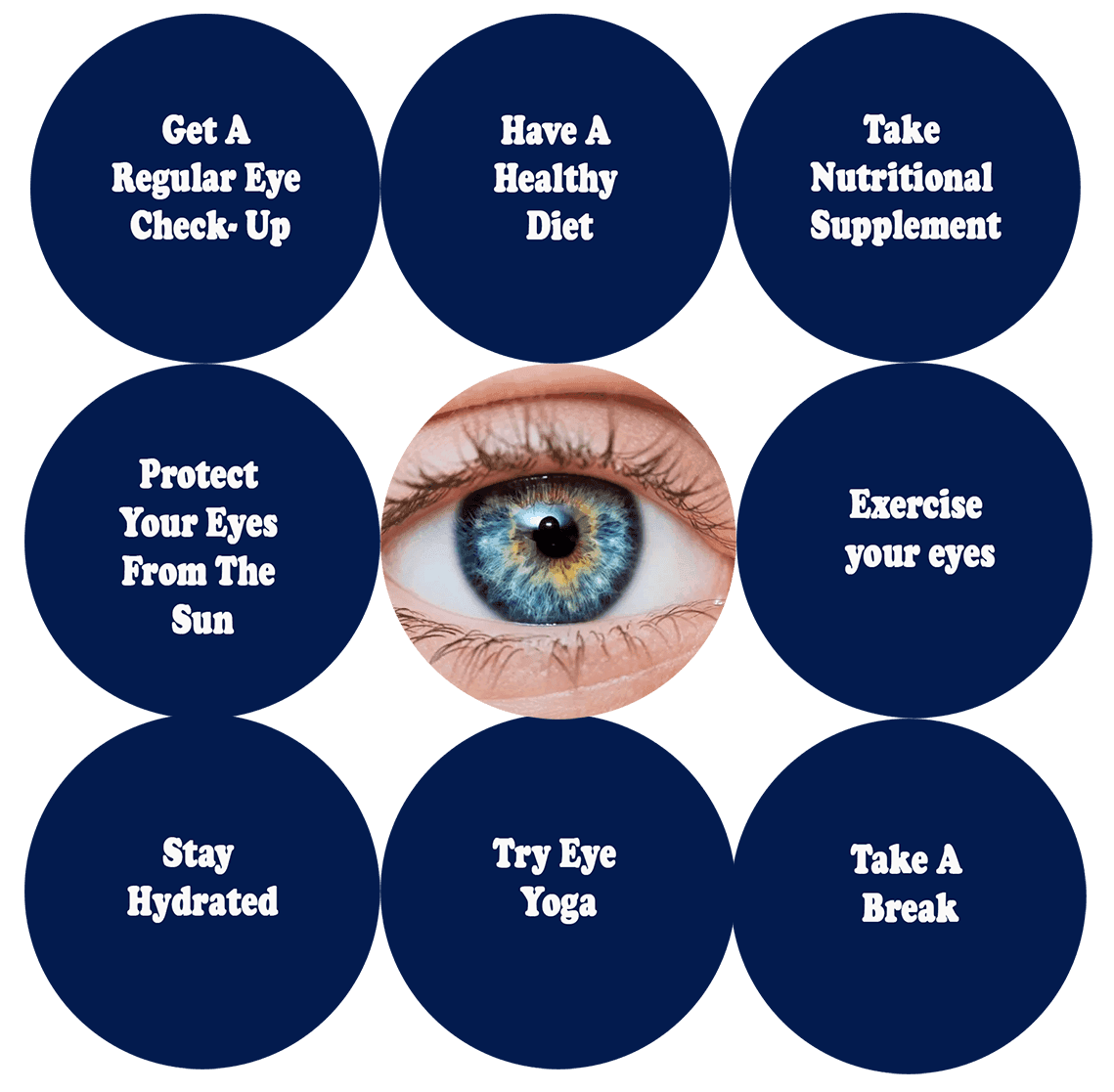
- Get a regular eye check-up
- Have a healthy diet
- Take a nutritional supplement
- Protect your eyes from the sun
- Exercise your eyes
- Stay hydrated
- Try eye yoga
- Take a break